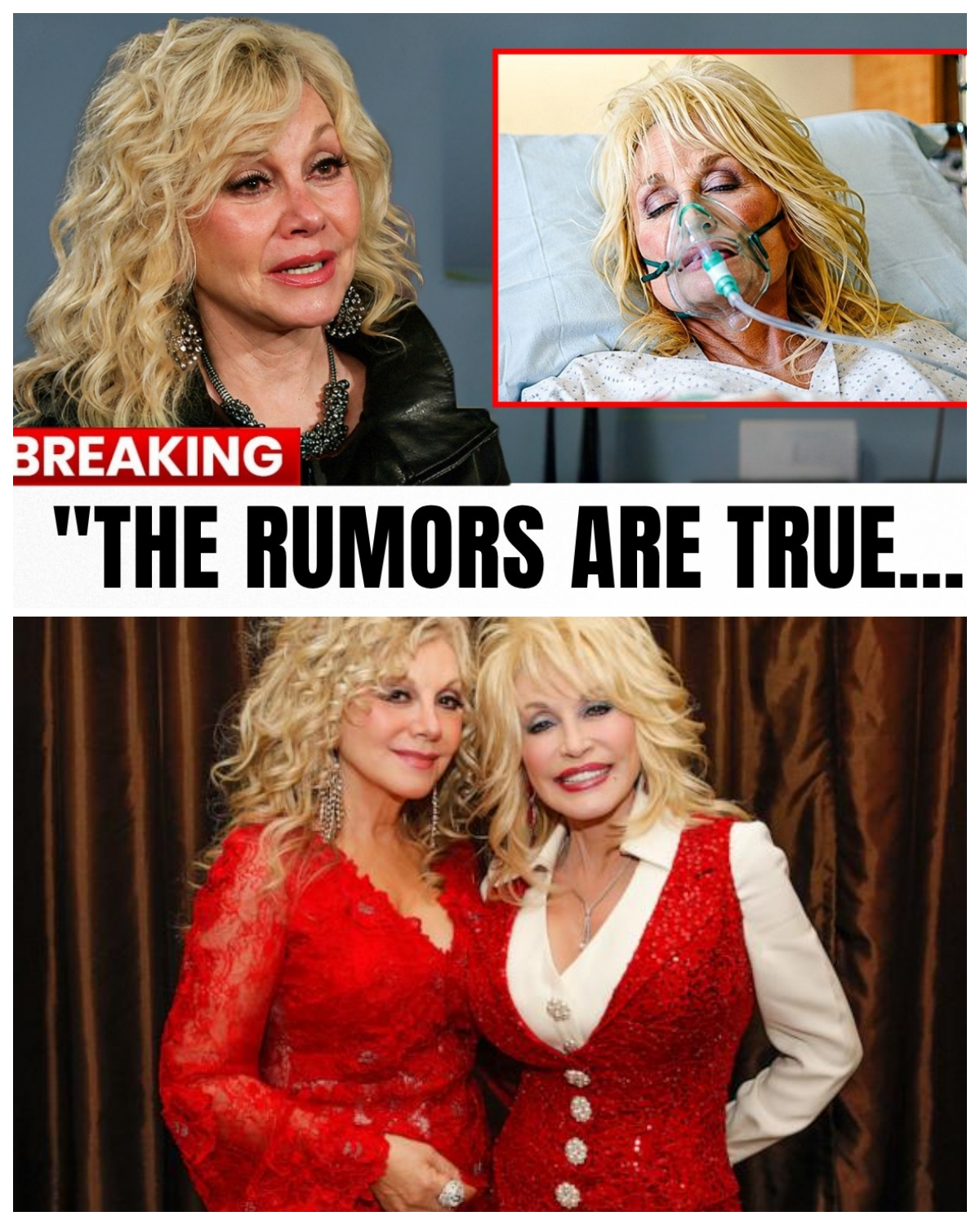
According to multiple reports, the singer was admitted to Vanderbilt University Medical Center in Nashville on Friday, August 21st.
For 60 years, millions of people welcomed Dolly Parton into their homes, their car radios, and their record collections.
That laugh, those songs, that warmth that never seemed to run out.
She felt like a woman the whole world already knew.
And in some strange way, we did know her because she [music] let us.
Then her younger sister, Stella, posted a short message online that stopped [music] people cold.
It was not an announcement.
There was no diagnosis in it, no hospital, no timeline, no explanation of any kind.
It was a quiet request written in the plainest language a person can use.
And when Dolly answered it herself with four words, the whole world exhaled and moved on.
10 months later, those four words read very differently because there is a line inside what Stella wrote that almost nobody read properly at the time.
On the surface, it looked like a woman calming things down.
Looked at now, it reads like something else entirely, and once you see it, you cannot unsee it.
So, what was Stella actually trying to tell us?
Stay with me all the way to the end of this one because when the timeline gets laid out end to end with nothing removed and nothing softened, it does not look anything like the story we all agreed on last October.
Let’s take a closer look.
The sister who never learned to stay quiet.
Before we get anywhere near October of 2025, you need to understand one thing about Stella Parton.
And the fastest way to understand it is a song she released in 1975 that almost nobody remembers.
She was 26 years old.
She had no career yet to speak of [music] and she used that moment to pick a fight with the entire country music establishment on behalf of a woman she barely knew.
Here is the situation she walked into.
Olivia Newton John, an Australian pop singer, had started collecting major country music awards in the United States.
According to reports from the time, a section of the American country establishment reacted badly.
The argument went that she was not really country, that she had not earned it, that an outsider had no business taking home trophies that supposedly belong to Nashville.
It got personal, it got loud, and it was popular, which is the part that matters.
Taking that side cost a person nothing and won them friends.
Very few people inside Nashville were reportedly willing to say a single word in her defense.
Careers are built on staying quiet in situations exactly like that one.
Stella Parton wrote a song defending her.
She called it Ode to Olivia.
Understand what she was risking.
[music] She had a brand new record label that she had funded herself.
She had one sH๏τ at a first impression and she spent it planting herself on the unpopular side of an industry argument for a stranger with nothing in it for her at all.
Nobody asked her to do it.
Nobody rewarded her for it.
And think about the arithmetic of that decision for one second because it is genuinely difficult to explain by any normal logic.
She was an unknown artist with a famous surname.
The obvious move, the move almost anyone would have made, was to stay pleasant, stay neutral, keep every door open, and let the family name do the quiet work of getting her into rooms.
Instead, she reportedly spent her first release taking the side of an outsider against the loudest voices in her own industry in a fight she had no stake in whatsoever.
You do not do that for strategy.
There is no strategy in it.
You do that because something in you cannot stand watching a person get treated unfairly while everybody in the room studies their shoes.
Hold that image in your mind because half a century later she is going to do exactly the same thing again.
Same instinct, same cost.
Only this time it will not be about an awards show.
This time it will be about her own sister.
And instead of Nashville ignoring her, the entire internet is going to turn around and tell her she was wrong.
So, where does an instinct like that come from?
It comes from a small house in the Tennessee hills [music] and from a lesson she learned before she could tie her own shoes.
Stella May Parton was born on the 4th of May 1949 [music] in Seviaville, Tennessee.
She was the sixth of 12 children born to Robert Lee Parton Senior and AV Lee Parton.
Dolly had arrived 3 years ahead of her.
Picture that house because the details explain everything that follows.
The home was small.
The money was thin.
There was almost nothing inside those walls that could be called private and even less that could be called yours alone.
12 children does not leave much room for secrets.
It also does not leave much room for a child who wants to be told that she is special.
That one detail matters more than it looks because it explains something about Stella that people would misread for the next 50 years.
In a family that size, a child did not get heard by waiting her turn politely.
There was no turn.
There was no cue.
A child got heard by opening her mouth and making a sound loud enough to cut through 11 other voices.
[music] Stella figured that out early.
And she never once stopped.
She [music] did not just speak either.
She performed.
At 7 years old, she and Dolly appeared together on a local television program in Knoxville.
[music] 2 years after that, she made her radio debut.
Run those numbers again.
Before Stella Parton turned 10, she had already been on both television and radio.
[music] In Sevia County in the 1950s, for a child from a family with that many mouths to feed, that was close to unimaginable.
These were not connected people.
This was [music] not an industry family.
This was a household where a new pair of shoes counted as an event.
And the sisters kept going.
Stella, Willardine, and Cᴀssie formed a group of their own, singing gospel music and recording commercial jingles around eastern Tennessee.
Real work, paid work.
Children singing for money, because singing was the one thing the family owned that other people were willing to buy.
That is the part outsiders never grasped about the partons.
Music was not the family ambition.
Music was simply what the family did in church [music] on the porch.
Around the kitchen table and eventually when somebody offered a few dollars for it [music] in front of a microphone.
Nobody in that house was chasing fame, they were chasing rent.
By high school, Stella had started writing her own songs.
And then life moved considerably faster than her career did.
She married Marvin Carol Ralhof shortly before graduating in 1966.
She had a son.
For a while, the music stopped being the plan.
It became the thing she fitted around everything else, around a marriage, around a baby, around the ordinary, relentless arithmetic of a young mother’s day.
This is the exact point in the story where most talented people quietly disappear.
Not dramatically, not with a decision.
They simply run out of hours and never find them again.
She came back anyway.
In 1967, she recorded her first album, a gospel project called In the Garden, made alongside her mother, Ay Lee, and her sisters, Willardine and Cᴀssie.
No commercial calculation behind it.
Four women from one family singing hymns onto tape.
Not long after that, she did something that took real nerve.
She left Tennessee entirely and moved to Washington, DC, where she began performing at a club called Hillbilly Heaven.
Understand what that actually looked like.
There was nothing glamorous about it.
No cameras.
This was a working singer earning a living in rooms where nobody had bought a ticket specifically to see her.
Rooms where people talked over the songs.
Rooms where you finished at 1:00 in the morning and carried your own gear out to the car.
She did that for years while her older sister’s name grew larger by the month.
And then came 1975, the year that should have changed everything.
[music] By that point, Stella had been performing professionally for close to two decades, and she still did not have a record deal.
Think about how strange that is.
She had the voice, she had the songs, [music] she had the experience, and she had a surname that by then was one of the most valuable in country music.
Any label in town would have taken her call.
She never made the call.
[music] Instead of waiting for a company to take a chance on her, she went and built her own.
She founded a label, named it Soul, Country, and Blues, and in September of that year, she released her debut solo album on it, I Want to Hold You In My Dreams Tonight.
In Nashville in 1975, a woman starting her own label to put out her own record was not a strategy.
It was close to heresy.
The system did not work that way.
Artists were chosen.
Artists were signed.
Artists waited their turn.
Stella did not wait.
And the gamble worked.
>> [music] >> The тιтle track climbed into the country top 10, peaking at number nine.
A genuine hit by any measure and strong enough to do exactly what it needed to do.
The following year, Electra Records signed her.
She had forced the door open by herself and then walked through it on her own terms.
That was who she was at 26.
It is who she would still be at 76.
50 years of being introduced as somebody’s sister.
Now, here is the sentence that follows Stella Parton through five decades of press clippings, concert programs, and television introductions.
Dolly’s little sister.
Four words that arrived in the room before she did every single time for 50 years.
And for most performers, that ᴀssociation would have been the single most valuable ᴀsset they owned.
It opens doors.
It fills seats.
It gets your calls returned.
A person could build an entire modest career on it without ever writing one good song.
Stella spent half a century politely declining to use it.
There is a real difference between resenting a shadow and simply refusing to hide inside one.
She never spoke about her sister with bitterness.
She never played the wounded sibling.
She just quietly, stubbornly insisted on being judged for her own work, which is a far harder road and a considerably lonelier one.
Sit with what that costs because most people never have.
Imagine being genuinely good at something.
Not pᴀssable.
Good.
Good enough that if your name had been anything else on earth, people would have argued about how good you were.
Now imagine that every time you walk into a room, before you open your mouth, before you sing a note, everybody in that room has already decided what you are.
Not a singer, a relative.
Imagine the interviews where the first four questions are about somebody who is not in the building.
[music] Imagine finishing a show you spent a year building and the first thing a stranger says to you afterward is a question about your sister’s hair.
Now imagine doing that for 50 years without ever once becoming bitter about it in public because that is the part that stays with me.
Across five decades, there is no recording, no interview, no throwaway line anywhere in which Stella Parton took a swing at Dolly.
[music] Not one.
She had every opportunity.
There was money in it.
There is always money in a famous person’s relative who is willing to be unkind.
She never took it.
The tabloids would have paid for that story.
[music] Nashville would have devoured it, and she simply refused to supply it year after year while going out and doing her own work in front of audiences a fraction of the size.
That is not a woman living in a shadow.
That is a woman who looked at the shadow, decided it was not hers, and walked around it every single day for 50 years.
And the work itself was real.
The Electra years were the closest she ever came to standing entirely on her own two feet.
>> [music] >> Between 1977 and 1978, she landed three top 20 country hits.
The Danger of a Stranger, which crossed the Atlantic and reached the top 40 in the United Kingdom, which almost no American country single of that era managed, Standard Lie number one, and Four Littles.
She recorded a duet with Carmel Taylor.
In 1979, she scored another hit with Steady as the Rain, a song written by Dolly.
She made three albums for the label before leaving in 1980.
Depending on which count is used and how you handle the compilations and the gospel projects, [music] Stella Parton has released somewhere between 17 and 23 albums across her lifetime and has charted more than two dozen singles.
Read those numbers slowly.
[music] Those are not the numbers of a hobbyist trading on a famous surname.
Those are not the numbers of somebody who showed up for 2 years and drifted away.
[music] Those are the numbers of a professional who worked without stopping for five decades.
And she refused to stay inside music.
Stella went into theater, touring in New York productions, including Best Little Wh House in Texas and Seven Brides for Seven Brothers, which demands a completely different set of muscles from a recording career.
She appeared on The Dukes of Hazard.
[music] In 1984, she recorded a song for the soundtrack of Rhinestone, the film her sister starred in.
And decades later, she appeared in Dolly Parton’s Coat of Many Colors, [music] the television film built around the family’s own childhood.
Think about what that job actually asked of her.
She walked onto a set and performed inside a reconstruction of the story she had personally lived through.
Someone else played her mother.
Someone else played her sister.
Someone else played the house.
And Stella Parton stood in the middle of it and did her lines.
That takes a steadiness most people do not possess.
She kept releasing records long after the chart success faded, eventually landing at Raptor Records, where she has gone on putting out work that almost nobody outside her own audience ever hears about.
And she kept talking.
Stella became known for speaking about poverty and about domestic violence, causes rooted in the world she came from rather than the one she had moved into.
She was named an honorary ambᴀssador of country music in New Zealand and reportedly received similar honors in Kentucky, Louisiana, and Pennsylvania.
In 2004, the Christian Country Music ᴀssociation named her its female vocalist of the year.
But the reputation that followed her around Nashville had very little to do with awards.
It came down to one simple inconvenient quality.
She said things out loud.
She spoke about how the industry treated women at times when that was not a conversation anybody wanted to have.
She spoke about politics even when her own fans told her plainly and repeatedly that they would rather she did not.
And then she pushed back on them for asking her to be quiet.
She put her name on causes that offered her nothing whatsoever in return.
Some people found that refreshing.
A great many others found it exhausting.
In 50 years, nobody ever found it fake.
And that one distinction is the entire reason the events of October 2025 landed the way they did.
When a woman who has never once performed for public approval, who has never played the game, who has never softened a single opinion to sell a record, suddenly starts talking in public about her sister’s health, it carries a completely different weight than it would coming from almost anybody else alive.
Stella was not the family spokesperson.
She had never been the one managing the message.
She had no interest in the machinery of any of it.
She was simply the one who had never learned how to say nothing.
If this story is landing for you so far, take one second and hit that like ʙuттon because it genuinely helps this channel reach more people who grew up with these songs.
And if you are new here, subscribe because we go deep on the stories behind the music every single week.
Now, to understand why Stella and her sisters were so uneasy that autumn, we have to move back a few months first.
The years that took almost everything.
Start with the brothers.
According to what has been reported, across a small handful of years, the Parton family lost three of Dolly’s brothers.
For 12 children raised inside one small house in the Tennessee hills, that is not a statistic.
That is the steady erosion of an entire childhood, one person at a time.
Every one of those losses removed somebody who remembered the same winters, the same hymns, the same mother, the same kitchen.
[music] somebody who could confirm that it had all happened the way you remembered it.
There are only so many people alive who share your first 10 years.
When they begin to go, something goes with them that no amount of success can replace.
Then [music] in March of 2025 came the loss that reportedly changed everything.
[music] And it involved a man that almost nobody on this planet had ever actually seen.
Carl Dean was Dolly Parton’s husband for close to 60 years.
She met him when she was 18 on the very first day she moved to Nashville.
Not a week in, not a month in, the first day.
She had finished high school in Sevia County and driven straight to the city with everything she owned.
And according to the story she told for decades, a young man in a white car spoke to her while she was standing outside a laundromat.
That was the entire beginning.
And their marriage went on to become one of the most fiercely protected private lives in the history of American entertainment.
He gave no interviews.
He walked no red carpets.
He did not appear in the documentaries, the specials, or the magazine spreads.
In a career built entirely on being visible in a life where nearly everything else was available to the public, Carl Dean remained the one part of Dolly’s world that stayed permanently her own.
She talked about him constantly.
She almost never showed him.
That was the arrangement.
And she kept it for six decades.
And maintaining that arrangement was not a small thing.
Think about the pressure.
60 years of magazine covers, 60 years of documentary cruise, 60 years of people reportedly offering serious money for one pH๏τograph, one quote, one afternoon with the man standing behind the most famous woman in country music.
Every one of those approaches had to be refused over and over again, decade after decade in a business where declining publicity is treated as a kind of illness.
She protected him from all of it completely for the entire length of their life together.
Which means that when he became ill, she protected that too.
There were no updates, no statements, no carefully released pH๏τograph of a couple facing something difficult together.
The private life stayed private right the way through the hardest part while Dolly Parton walked out onto stages, gave interviews, sold records, and smiled that smile carrying something the audience knew nothing about.
That is a particular kind of strength.
It is also a particular kind of isolation.
He died in March of 2025, reportedly at the age of 82.
And Dolly was open about what came afterward, although she said it lightly, the way she said almost every difficult thing.
A joke first, then the truth underneath it, delivered fast enough that you could miss it if you were not paying attention.
According to her own public comments, she had spent a long stretch of years caring for Carl [music] while he was seriously ill.
Not weeks, years.
And through all of that time and in the months that followed, she had not been looking after herself at all.
She said so publicly more than once in her own words.
[music] She had not paid attention to her own body.
She had not chased down her own symptoms.
She had not taken her own condition seriously because her attention had been somewhere else entirely.
Anybody who has ever nursed somebody they love through a long illness knows exactly what she was describing.
[music] You stop noticing yourself.
Your own aches become background noise.
There is always something more urgent happening in the next room.
And Stella carried all of it, too.
She spoke about it openly, describing the necessity of laughter and what she called a philosophical approach to a season that would not stop taking people away from them.
She did not dress it up.
She did not dress it up.
She did not dress it up.
She did not dress it up.
She did not dress it up.
She did not dress it up.
She did not dress it up.
She did not dress it up.
She did not dress it up.
She did not dress it up.
She did not dress it up.
She did not dress it up.
She did not dress it up.
She did not dress it up.
She did not dress it up.
She did not dress it up.
She did not dress it up.
She did not dress it up.
She did not dress it up.
She did not dress it up.
She did not dress it up.
[music] She did not dress it up.
She did not dress it up.
Seven.
From a woman who had been recording since she was a teenager, who had built her own label rather than sit still, who had never in her adult life gone a full year without working on something.
She later described those years in exactly these terms, years of grief and loss.
So now put every piece of it together and stand where those sisters were standing in the autumn of 2025.
A woman in her late 70s who had just lost her husband of six decades.
A woman who had buried three brothers in recent memory.
A woman who had reportedly spent years as a full-time caregiver and let her own health slide the entire way through it.
A woman who had admitted out loud in her own words that she had ignored her symptoms because somebody else had needed her more.
Her sisters were not spreading a rumor.
They were not fishing for attention.
They were not being dramatic.
They were describing the person standing directly in front of them.
And still, because it was Dolly, because she smiled and made a joke and got straight back to work the way she always had, almost every one of us chose to believe the smile.
That is not a criticism of anybody.
It is simply what happened.
We wanted the smile to be the truth so badly that we accepted it as evidence.
The post that set off everything.
In early October of 2025, Freda Parton posted a message asking people to pray for her big sister.
That was all of it.
That was the entire content.
No diagnosis, no details, [music] no explanation of what specifically was wrong.
No hospital, no [music] timeline, a younger sister on her own page asking for prayers.
For almost any other family on Earth, that post would have vanished into the ordinary noise of the internet inside 20 minutes.
But this was Dolly Parton.
Within hours, according to reports at the time, that post had been screensH๏τted, reposted, clipped, [music] quoted, and rewritten into something enormously heavier than Freda had ever intended.
[music] It stopped being a private request and became a news event.
Headlines appeared.
Aggregators picked it up and then the thing happened that always happens now.
The thing that has become one of the ugliest features of modern life.
Fans began writing tributes [music] in comment sections before anybody had confirmed there was anything at all to write a tribute about.
People were grieving a woman who was at that exact moment reportedly sitting in a studio filming a commercial.
And the strangest part was this.
The word everybody was so carefully avoiding was doing far more damage than the word itself would have done.
Nobody would say it so everybody imagined it.
And the imagining ran miles ahead of anything anyone actually knew.
There is a reason it moved that fast and the reason is not cruelty.
Dolly Parton had been inside people’s lives for 60 years.
She was in the car on the way to school.
She was on the radio in a kitchen where somebody’s grandmother was cooking.
She was the voice at a wedding, at a funeral, on a night that went badly.
Millions of people had a relationship with her that she could never have had with them because it only ran in one direction.
That is not fandom.
It is closer to family and it behaves like family.
[music] So when a genuine sister asked for prayers, millions of people who had never met the woman felt the floor move under them and they reacted the way anybody reacts to bad news about somebody they love.
They did not wait for confirmation.
They did not check the source.
They simply started grieving because the possibility alone was more than they wanted to sit with.
[music] The internet did not turn on Dolly Parton that week.
The internet panicked about her and panic on that scale drowns out the quiet voice trying to tell you something precise.
Now, here is what makes that whole week so difficult to look back on.
The first real signal had already come and gone almost completely unnoticed.
In late September of 2025, roughly a fortnight earlier, Dolly Parton had postponed her Las Vegas residency.
The stated reason, according to the announcement at the time, was health challenges.
Stop and think about that.
Coming from any other artist approaching 80 years of age, that would have been treated as significant news.
It would have been the headline.
There would have been follow-up questions.
Coming from Dolly Parton, a woman who had toured relentlessly for six decades, [music] who had built a reputation as the hardest working person in the business, who had reportedly cancelled almost nothing in her entire life.
It was reported once and quietly set aside.
The very consistency that made her extraordinary is what made the warning invisible.
She had never let us down before, so nobody read it as inability.
Everybody read it as scheduling.
Freda’s post was not the beginning of the story.
It was the second signal [music] and within days a third arrived.
Stella posted as well.
This is the moment people would return to almost a year later and read completely differently.
Stella addressed those with genuine concern for her big sister’s well-being and pointed them toward what Dolly had already said herself.
Look closely at that because it is doing three separate things at once and only one of them was obvious at the time.
On the surface, it reads like a calming statement, a gentle redirect.
[music] Nothing to see here.
Go and read the official word.
Underneath that, it is a filter.
She separated the people with genuine concern from the people enjoying the drama and addressed only the first group.
That is a woman drawing a line in public.
But the third thing is the one that matters and almost nobody caught it.
She did not deny anything.
She did not say her sister was fine.
She did not say the worry was misplaced.
[music] She did not say there was no reason for any of it.
She pointed at what Dolly had already admitted publicly, which was that she had not been taking care of herself and had been dealing with health issues.
Stella pointed at a truth that was already sitting in plain sight and trusted people to go and read it properly.
They did not go and read it properly because the post was measured and because it was not dramatic, it got filed as a walk back.
But it was still a second part and sister publicly acknowledging that the concern was real.
And for an enormous number of fans, that acknowledgement was actually worse than the original post.
One sister asking for prayers can be a private moment made public by accident.
Families do that.
Two sisters speaking within days of each other starts to look like something else.
The reaction grew large enough that Dolly answered it personally.
She recorded herself sitting in a studio in the middle of a commercial shoot for the Grand Old Opry and posted the video with a caption that traveled around the world in an afternoon.
Four words, “I ain’t ᴅᴇᴀᴅ yet.”
[music] It was perfect.
It worked completely and there is a reason it worked so well.
Look at how carefully that video was actually built.
She said the date out loud so nobody could claim the footage was old or recycled.
She said she wanted to put everyone’s minds at ease.
She acknowledged directly that after her husband pᴀssed away, she had not taken proper care of herself.
She described what she was dealing with as nothing major.
She explained that she had canceled commitments in order to stay close to home and receive treatment.
And then she asked people to keep praying anyway.
Then she went straight back to work.
Now, slow down here [music] because there is a detail inside that video that almost everybody sailed straight past and it may be the most important detail in this entire story.
[music] Listen to what she actually said.
She said she was not ᴅᴇᴀᴅ.
True, funny, and exactly what a frightened audience needed to hear.
She said what she was dealing with was nothing major.
She said she had canceled commitments to stay close to home.
She said she was receiving treatment.
She said she had not taken proper care of herself after her husband died.
And then she asked for prayers to continue.
Go back through that list and find the part where she said she was well.
It is not there.
She never said it.
Not in that video and reportedly not once at any point across the 10 months that followed.
What she said consistently, plainly in her own voice again and again was that she was healing, that she was working on it, that her doctors were working on it, that she hoped to be up to snuff soon.
Healing is not the same word as healthy.
Treatment is not the same word as recovered.
[music] Nothing major is a reᴀssurance about severity, not a promise about outcome.
[music] She told the truth every single time she was asked.
She simply told it with a joke wrapped around it and we heard the joke and stopped [music] listening.
That is not deception.
She was not hiding anything from anybody.
She was doing what she had done her whole life, which was to hand people difficult information in a shape they could carry.
We were the ones who put it down.
The relief was enormous and it was instant.
You could watch it move across the internet in real time and then notice what happened next.
[music] Because this is the part that matters most.
The story did not just resolve.
It flipped inside a single news cycle.
The narrative was no longer that Dolly Parton was unwell.
The narrative became that her sisters had frightened everybody over nothing.
The story stopped being about her health and became about their overreaction.
Afraid returned to Facebook the following day to soften it.
>> [music] >> She explained that she had not meant to alarm anyone or make things sound as serious as they had come to sound.
She said her sister had simply been a little under the weather.
She said she believed deeply in the power of prayer.
She called it nothing more than a younger sister asking for prayers for her older sister and thanked everybody who had answered.
[music] And that is where the whole thing was left.
A misunderstanding, an overprotective family.
A star who was fine, who was funny about being fine, and [music] who had proved it on camera in under a minute.
Case closed.
Everybody move along.
Now look at that same sequence again with everything we know now, and something much quieter comes into focus.
Three signals arrived inside two weeks.
A canceled residency citing health.
One sister asking for prayers, a [music] second sister confirming the concern was real.
Two women who had known Dolly her entire life were worried enough to say so publicly at a moment when nobody outside that family had any particular reason to be worried at all.
They were not guessing.
They were not speculating.
They were not reading tea leaves off a canceled residency the way the rest of us were.
They were standing closer to the situation than any other people on Earth.
And they were the only ones who could see it properly.
And everyone else decided they had it wrong.
Everyone else was not in the room.
A year of quiet warnings.
What makes the following 12 months so difficult to look back on is that the signals never actually stopped arriving.
Not once.
They simply kept coming [music] slowly and cheerfully wrapped in jokes and good news.
And every single time it was easier to file one away than to add them all up.
Start with the last one because it is the one everybody remembers.
In August of 2026, reportedly only days before the end, Dolly gave a final public update.
She told people she had been through some hard times with her health.
She admitted one more time that she had ignored her own condition while she was watching over Carl.
And even [music] so, she said she was still healing and still working.
Still working.
That was the phrase everybody held on to.
That was the phrase pulled into every headline because it was the phrase that allowed the whole world to relax.
It was [music] also in hindsight the exact phrase that made it possible to believe there was more time.
Now rewind 8 months [music] and watch how that year actually unfolded.
In January of 2026, Dolly Parton turned 80 years old.
The state of Tennessee marked the occasion by declaring the 19th of January as Dolly Parton Day with the governor reportedly signing a proclamation honoring her music, her philanthropy, and her place in the history of the state.
[music] It was a celebration.
It was completely deserved.
Nobody has done more for that corner of Tennessee than she did.
It was also, if we are being honest, the kind of tribute that tends to arrive when a great many people have quietly begun to sense that a story is entering its final stretch.
Nobody ever says that out loud.
Nobody would.
Proclamations get signed, [music] statues get commissioned, lifetime achievement awards get handed over, and there is always a stated reason.
And underneath the stated reason, there is usually a feeling.
In March of 2026, she made her first in-person public appearance of the year, opening Dollywood’s 41st season.
And she looked like herself.
[music] She sounded like herself.
The hair, the smile, the timing, the laugh, everything in its right place.
She told the crowd she had been busy with a great many things.
She told them she had not been touring.
She told them she had experienced a few little health issues and that they were being taken care of.
She spoke about focusing on healing after losing Carl.
[music] At one point, she joked that the audience should not mistake the park’s president for a new boyfriend, making clear she was not seeing anybody.
Every part of that appearance was reᴀssuring.
That is genuinely how it felt at the time and that is how it was reported.
She showed up.
She was funny.
She was Dolly.
But strip away the delivery and read the actual content of what she said.
She was not [music] touring.
She had health issues.
She was focused on healing.
Every part of that appearance was reᴀssuring.
Every part of it also contained an admission.
That was the pattern for the entire year.
And it was remarkably effective.
And there is no reason to believe it was calculated.
That was simply how she was built.
Tell the truth, but tell it with a smile on so that nobody has to carry it except you.
Then May of 2026 arrived and the picture sharpened considerably.
Dolly canled the Caesar’s Palace residency outright.
Not postponed, cancelled.
And this was the same run that had already been pushed once from December of 2025 all the way out to September of 2026.
[music] She explained it herself in a video the way she explained everything.
According to that video, she had always had trouble with kidney stones.
She said her immune system and her digestive system had been out of balance for a stretch of years and that her doctors were working hard to rebuild and strengthen both.
She said she hoped to be up to snuff again soon.
And then because she was still Dolly Parton and stopping was not something she had ever learned how to do, she mentioned that she was still developing her Broadway project.
Read that again.
She is cancelling a residency because her body will not allow it.
And in the same breath, she is telling you about the next thing she is building.
That is not deflection.
That is a person who could not imagine an empty schedule.
And that same month, Stella Parton made an announcement of her own that almost nobody connected to any of this.
After 7 years away, she wrote that she had finally found the focus to make new music again.
>> [music] >> She described that absence in her own words.
Seven years filled with grief and loss.
She said she wanted the new project to carry a message about keeping hope alive.
And she wrote about the previous decade in blunt terms, a period of losing loved ones while watching the country she loved come apart.
Then people told her one more time the way they had been telling her for 50 years to leave the politics alone and just sing.
She refused.
She was half a century into a career built on not being told what to say.
She was 77 years old.
She was not about to start taking instructions.
[music] And she followed it with a new song.
She called it Stand by Me.
At the time that read as a comeback story, a woman finding her way back to her work after a rough decade.
Warm, easy, simple to scroll past.
[music] Read it again knowing what reportedly came 3 months later and the timing does something else to you entirely.
Seven years of silence [music] broken right then.
She names the thing she wants the record to be about and the thing is hope.
[music] And the song she leads with is called Stand by Me.
Nobody outside that family can say what she knew or when she knew it.
And it would be wrong to claim otherwise.
But a woman who had said nothing for 7 years chose that specific spring to start speaking again.
In June, she gave interviews about how the family had endured what the last few years had thrown at them.
And she returned, as she always did, to the same two things, laughter and a philosophical approach.
Read those June interviews at the time, and they sound like a woman processing the past.
Read them now and they sound like a woman quietly bracing for something which brings the year back around to August and to that final update [music] and to the two words everybody chose to hear still working.
But before we get there, count what that year actually contained because laid out in one place, it looks nothing like it did while it was happening.
A residency postponed in September of 2025, citing health.
Two sisters speaking publicly within days of each other in October.
A video in which she confirmed she was receiving treatment and never once said she was well.
A state proclamation in January.
A season opening in March where she confirmed she was not touring and was dealing with health issues.
A residency canled outright in May with a stated explanation involving her immune system and her digestive system being out of balance for a period of years.
A sister breaking seven years of silence that same month with a record about keeping hope alive and interviews in June about how a family survives a season of loss.
Eight signals in 11 months.
Every single one of them was reported.
Every single one of them was public.
Not one of them was hidden from anybody.
We simply took them one at a time and one at a time they were survivable.
What Stella was really telling us.
According to the announcement shared publicly by her family on Tuesday the 25th of August 2026, Dolly Rebecca Parton Dean died peacefully at her home in Nashville.
She was 80 years old.
And the way that news reached the world says nearly everything about the woman it was about.
It did not come from a publicist.
[music] It did not come from a network.
It did not come from a label or a press release or a carefully worded corporate statement.
It came from her nephew Brian Sver in a video posted to her own social media accounts.
Sver had reportedly served as her head of security for more than 20 years, a role his father had held before him.
Two generations of one family standing beside her.
And in that video, he revealed something that stops you cold.
Dolly had asked him to record that message years earlier, [music] years, long before he was able to accept it as something that would genuinely one day happen.
She had thought about it, [music] planned it, chosen the person, and asked him while she was healthy and while there was no reason to because she wanted the news to come from somebody who loved her rather than from a stranger reading a statement.
He called it an honor mixed with pride and with sadness.
And then he said something worth sitting with.
He said, “The sadness belongs to those left behind rather than to Dolly.”
He spoke about the doors she had opened, not only for him, but for an entire family who never knew how far they could reach until she showed them.
That is the sentence.
That is the whole thing right there.
An entire family who never knew how far they could reach until she showed them.
12 children in a small house in the Tennessee hills.
And one of them walked out and made the ceiling disappear for all of them.
The family asked for a small private service.
[music] In place of flowers, they asked for donations to Dolly Parton’s Imagination Library, the program that has put free books into the hands of millions of children who might otherwise never have owned one.
Even in the announcement of her own death, she was still giving books to [music] children.
And the message closed with the only line it possibly could have, “She will always love you.”
And somewhere inside all of that is Stella.
At the time of recording this, she has not released a public statement of her own.
Think about that for a second.
The sister who spent 50 years being told she talks too much.
The one who could never be persuaded to be quiet.
[music] Not by fans, not by labels, not by Nashville, not by anybody.
Silent.
There is a particular kind of quiet that comes from a person who has spent a lifetime being criticized for speaking.
And this appears to be it.
It is not absence.
[music] It is not indifference.
It reads like the silence of somebody who has already said everything she had to say, was told she was wrong, [music] and now has nothing left she wishes to add.
Because here is what the timeline actually shows, laid out end to end with nothing removed.
Late September of 2025, a woman who canled almost nothing, cancelled something, and cited her health.
Early October, one sister asked the world to pray.
Days after that, a second sister confirmed the concern was real and pointed everybody toward what Dolly herself had already admitted.
Then Dolly made a joke and the joke was wonderful and it was funny and it was completely true.
She was not ᴅᴇᴀᴅ.
That is all she said.
She never once said she was well.
And everybody moved on with enormous relief.
The sisters were gently teased for the trouble they had caused.
They were painted kindly but firmly as the family who panicked.
They were not wrong.
They were early.
That is what Stella appears to have been telling us.
And in the end, she confirmed it without ever having to write another word.
Not a scandal, not a secret, not a cover up, not a conspiracy, not a hidden diagnosis, not one of the things the internet went hunting for.
Just the ordinary unbearable thing that families always know before the rest of the world is ready to hear it.
She had been standing close enough to see what was coming.
And she said so the same way she had been saying things since she was 26 years old, spending her one sH๏τ at a debut, defending a stranger that nobody else in Nashville would defend.
That is the through line.
That is the entire life.
51 years apart and it is the identical instinct.
See the thing everybody has agreed not to mention.
Say it anyway.
Except that it will cost you.
Do not expect thanks for it.
She was never the difficult sister.
She was the honest one.
And in a world built on managed images, those two things look almost identical from a distance.
For six decades, the world knew Dolly Parton as the woman who never seemed to age, never seemed to tire, and never seemed to stop giving things away.
We knew the wig and the laugh and the optimism that refused to break.
We knew the songs that soundtracked entire lives.
We knew the theme park that put a whole county to work.
We knew the library that put books into the hands of children who had none.
We knew the version she chose to give us and she gave it generously and none of it was false.
But her sisters knew somebody else.
They knew a woman who had just lost her husband of 60 years.
A woman who had buried three brothers.
[music] A woman who had spent herself all the way down to nothing, caring for somebody else, and had not stopped once, not for a single appointment, to care for herself.
They knew the woman behind the smile because they had known her before there was a smile to hide behind, before the wigs, before the records.
Back when she was one more child in a crowded house in the hills who sang too loud and dreamed too big.
They tried to tell us.
We heard the joke instead.
And who among us did not want to believe it.
[music] That is the honest ending.
And it is not a story about anybody being fooled.
It is a story about how badly all of us wanted the smile to be the whole truth.
Dolly gave us permission to believe it.
And we accepted that permission gratefully [music] because the alternative was unthinkable.
Her sisters never had that option.
They were too close.
Love at that range does not let you look away.
>> [music] >> So if you came here looking for a villain, there is not one.
There is only a woman who spent 60 years protecting everybody else from how hard things actually were.
And a younger sister who spent 50 years refusing to protect anybody from the truth.
Both of them were doing the same thing in completely opposite directions.
Both of them were trying to take care of us.
Only one of them was ever thanked for it.
Were you a fan of Dolly [music] Parton?
What was the first song of hers that ever got to you?
Share your memories with us in the comments below [music] because reading them is the best part of making these.
And if this story meant something to you, please like, share, and subscribe.
It costs you nothing and it helps this channel more than you know.
Also, click the next video shown on your screen right now.
You are going to want to see this